Guides
Inventory planning for florists: matching stock levels to steady demand
Florist inventory planning matches consistent demand with steady stock, tying stem cost and cooler space to cash so flowers sell before wilting.
What to take away
- Build an item master that lists each stem, hard good and supply by variety, supplier, bunch size, cooler location, lead time, cost per stem and substitute rule.
- Price a bouquet against stem cost plus labour, waste and delivery, not against what the shop across town charges.
- Sort every loss by causeunsold at the cooler, damaged in transit, trimmed in processing, or given away. One combined loss number tells you nothing.
- Staff to the holiday calendar, not to the quiet week. Valentine's and Mother's Day carry most of the year's volume.
- Write the item master before the busy week, not during it.
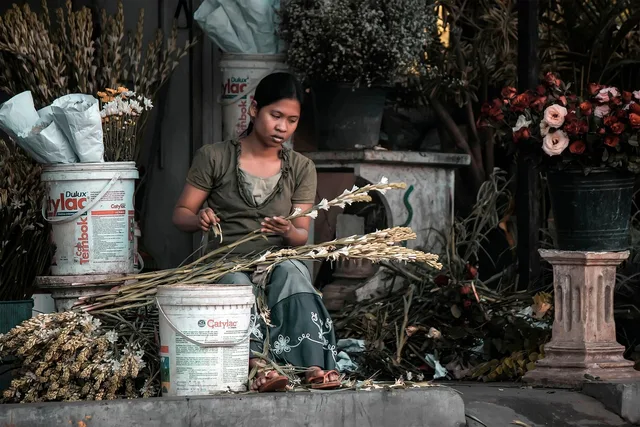
!Florist arranging bouquets at a workbench surrounded by buckets of cut flowers
This article covers business systems only. Licensing, import paperwork and workplace safety rules vary by province, state and municipality. Confirm current requirements with your provincial or state authority and a licensed customs broker.
What the item master holds
Every stem the shop sells gets one line. Record variety, grower or supplier, bunch size, and unit cost per stem.
Also record cooler zone, vase life in days, lead time, and reorder point.
Record the substitute you will accept when the exact variety is unavailable.
Set the par level at three days of cover, 120 stems when you sell 40 roses a day. Set the reorder point at the lead time demand plus half a day of safety: 100 stems when the lead time is two days.
Hydrangea at 6 stems a day with a one-day lead time gets a par of 18 and a reorder point of 10. Scale the same rule across the master for every variety you carry.
The substitute rule matters most. A wholesaler out of white ranunculus will send pink unless you have written down what is acceptable and what is a return.
One person owns the master and updates it weekly. When a line is wrong, that person fixes it the same day.
Supply routes
Fits when
- Direct from the grower
- You buy by the box and want named varieties
- Regional distributor
- You need breadth and next-day delivery
- Local wholesale market
- You want to see and pick stems same day
- Online marketplace
- You need small, irregular quantities
- Grower cooperative
- Several shops want the same volume
Watch for
- Direct from the grower
- Minimums sized for larger shops
- Regional distributor
- Substitutions made without asking
- Local wholesale market
- Limited range, early hours
- Online marketplace
- Cold chain breaks in transit
- Grower cooperative
- One member changing plans disrupts the order
A shop doing weddings needs the grower route for consistency. A corner shop doing daily arrangements usually runs better on the local market.
Supply Route Comparison
Direct grower
- Fits when
- Buy by box
- Watch for
- High minimums
- Delivery
- Grower schedule
- Shop type
- Weddings
Regional distributor
- Fits when
- Need breadth
- Watch for
- Silent substitutions
- Delivery
- Next-day
- Shop type
- Mixed orders
Local market
- Fits when
- Pick same day
- Watch for
- Limited range
- Delivery
- Same day
- Shop type
- Daily arrangements
Pricing a bouquet
Work in named variables, because your numbers are yours:
Bouquet Pricing Formula
- Stem costsum of every stem
- Labourdesign minutes x hourly rate
- Wastestem cost x waste factor
- Deliveryvehicle cost per stop
Retail price = (stem cost + labour + waste + delivery) x your markup. A bouquet priced off the competitor's window card will lose money on the weeks when roses spike.
A 12-stem bouquet: six roses at $1.00 a stem, four carnations at $0.50, two filler stems at $0.60, and $2.80 of greens and wrap. Materials come to $12.00.
Labour is 15 minutes at $20 an hour, or $5.00. Waste at 10 percent of materials adds $1.20, and delivery adds $4.00. Total cost is $22.20. At 2.5x the bouquet retails at $55.50; at 3x it is $66.60.
Track average order value monthly. If it falls while stem cost rises, the mix has drifted toward cheap arrangements.
Cold chain and the cooler
Cut flowers lose vase life for every hour above the recommended holding temperature. Your cooler spec sheet states the range; a thermometer on the door tells you whether you are inside it.
Hold most cut flowers at 34 to 38 F (1 to 3 C). Typical vase life at that range: roses 7 to 10 days, carnations 10 to 14 days, tulips 5 to 7 days. Tropical stems such as orchids need 50 to 55 F.
Check the cooler twice a day and log it. A cooler that fails on a Friday afternoon costs the weekend's stock.
The delivery van matters too. An unrefrigerated van in July turns a two-hour route into a wilted one. Route the longest stops first.
Staffing the holiday weeks
The [U.S. The Bureau of Labor Statistics floral designer profile is available at Bureau of Labor Statistics floral designer profile. The work includes:
- ordering
- processing
- arranging
- pricing
- displaying and caring for flowers
- consulting customers and coordinating deliveries
Holidays and events drive demand and schedules.
That last clause is the planning fact. Hire and train before the holiday, not during it. A designer who learns your cooler layout on February 13 is a liability on February 14.
Seasonal hires bring employment standards questions. Your provincial or state employment standards office publishes the current rules on hours, overtime and termination.
Federal rules in the United States come from the Department of Labor: minimum wage, overtime and youth employment under the Fair Labor Standards Act. Some states set a higher standard.
Records and safe work
The IRS recordkeeping guidance sets the standard: any system that clearly shows income and expenses, backed by the documents for purchases, sales, payroll and assets. Keep supplier invoices and delivery records in the same place.
The OSHA safety management guidance recommends finding and fixing hazards before an injury or inspection does it for you. In a flower shop that means box cutters, wet floors, cooler doors and van loading.
Preservative handling, chemical exposure and worker safety limits sit with the product's safety data sheet and your workplace safety authority. Read the sheet, do not guess.
Importing across the border
Cut flowers crossing into Canada need paperwork. The Canadian Food Inspection Agency sets plant health requirements and publishes the relevant directive; the Canada Border Services Agency handles entry. Work with a licensed customs broker rather than reading the regulations yourself.
Into the United States the rules differ. USDA APHIS sets plant health requirements and CBP clears the shipment at the port of entry. Most cut flowers are admissible, but some species and origins need an import permit or a phytosanitary certificate issued in the growing country.
Ask the broker which permits apply to your species and origin before you place the order, not after the truck reaches the border.
Where the plan lives
The florist business plan guide shows where inventory planning sits among the other decisions: pricing, staffing, cash and growth.
Common questions
How much stock should a florist hold?
Enough to fill the next three days of orders plus the holiday build, and no more. Anything past its vase life is a write-off, not inventory.
What is the biggest inventory mistake in a flower shop?
Buying on price alone. A cheaper box with a broken cold chain costs more than the premium box that arrives at the right temperature.
How do I know if my pricing is wrong?
Watch average order value and waste together. If order value is flat and waste is climbing, the markup is too thin to absorb the loss.
Do I need a customs broker to import flowers?
For commercial imports into the United States or Canada, yes. USDA APHIS and CBP run the US side; the CFIA and CBSA run the Canadian side. The requirements turn on species, origin and season, and a broker tracks the current directives.
For sourcing depth, the florist inventory and sourcing guide covers supplier selection and seasonal buying in more detail.